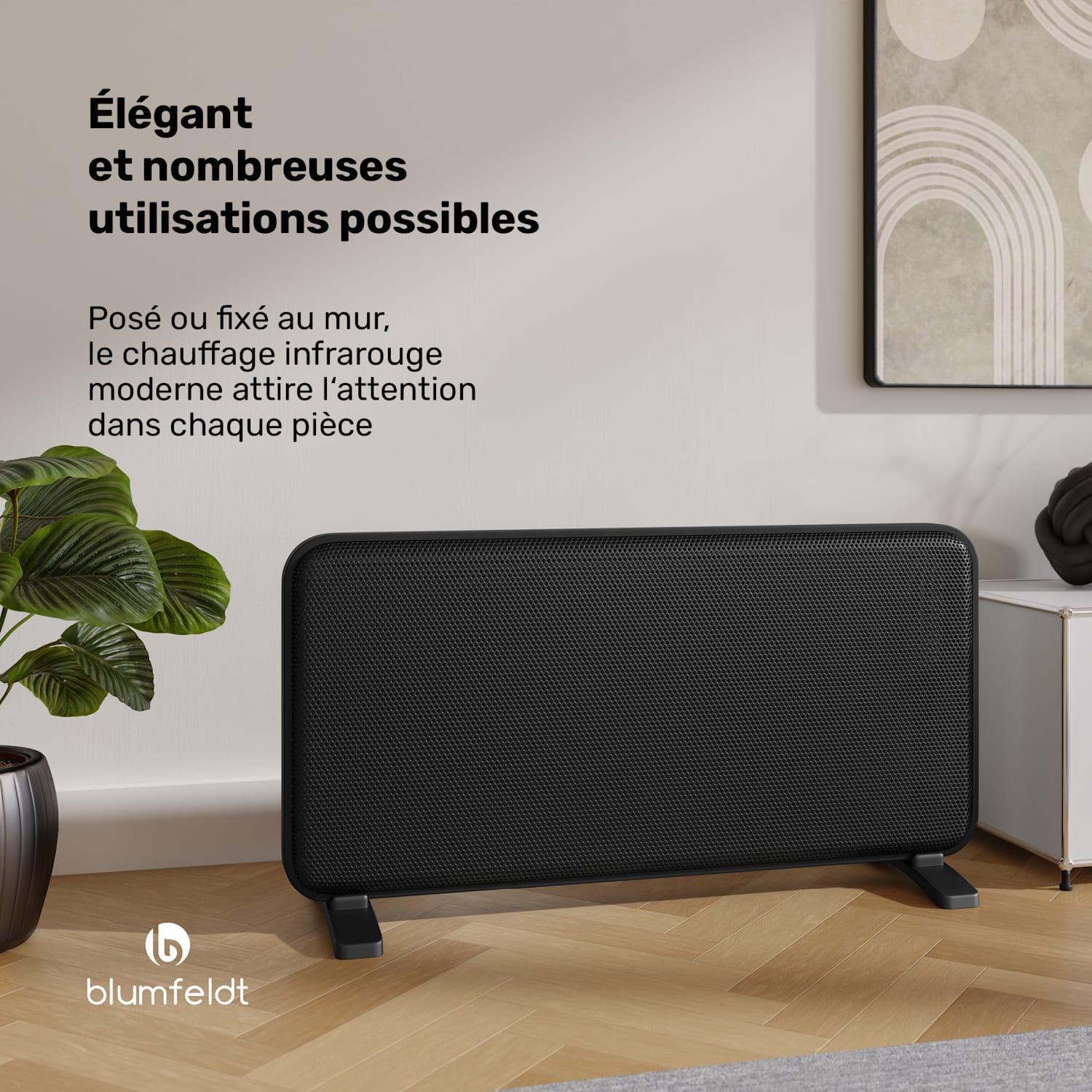
I bought this heater in combination with a 2000W mica heater for comparison after my house main heating system died and has to be repaired (try to find a tech guy that touches old gas heaters...).First off, it is not all far infrared. This heater has quite some convection heating going on too. Which is good.Sitting in the "light" side, meaning, in front of the heating panel lets you feel the radiation heat being absorbed by your skin. But on the "shadow" side, meaning on the backside or anything left or right or on top of it, as well as on the backside, things very much stay cold. My room thermometers stay 4 to 7 degrees C lower than the heaters thermostat, because they are on the "shadow" side of the heater. And the convection is maybe 20% max. on this type of heater.This heater is one-directional. The backside stays relatively cool and is fully covered.It has holes on its backside for wall- or if you are dangerously brave, ceiling mounting. Some spacers for that are included. Screws or other installation material are NOT. Considering the low range of the heating, it is most likely many buyers will use it standing nearby anyway - not on a wall far away not giving any radiation heat any more.On first use, open the windows for at least 10 minutes. It has a sweet chemical smell that fades slowly after 30 minutes of maximum power usage. After 10 minutes it is low enough to be safe, I think.The best part of this heater is that it is really and completely noiseless. No mains power frequency hum, nothing.And it seems quite safe. The top side is getting hot enough than you can burn yourself by touch. But 1cm away from the case the temperatures are safely low.Apropos case. It is a very stable steel frame (mine came with some plastic or steel parts rattling around on the inside), with a hexagonal front mesh out of steel with the flimsiest standing feet you can get. Which also have no rolls, in comparison to the advertising pictures. But since this heater is not very heavy, you can live with the cheap plastic feet. Unless you have children or pets which might fall or lean against the heater itself or kick it over.The thermostat is controlled by two infrared sensors on top of the heating element inside the case. Aprox. on the 1/4th and 3/4th position of the width. And since convection heat is just a small portion of this heating system, you get cold instantly when the thermostats turn off because they "sense" 24 degrees C when the rest of the room has only 16 degrees C. A sad disadvantage of this heating type. And bad placement of the temperature sensors, considering the take up the temperature of the IR reflection and the convection from the front grid itself (which explains the inaccuracy).And everything is depending on these not very accurate working sensors / thermostat, because you cannot control the heater otherwise. Turning the power off means for the heater, that if you turn the power on again, it stays off until you press some touch sensitive (resistive) buttons on the right side of the case to turn it on. So you will not be able to control the heater by a smart plug connected to a smart thermometer in the room.So compared to the mica heater I also bought, you either set the thermostat to 30°C and hope for the best or freeze.And the heat instantly goes away, when it turns off. The convection heat is just a too small portion to keep up. Objects radiated by the far Infrared cool off immediately. And that is why it feels weak. (Like you are OK when standing in the sunlight on a cold temperature and windy day and then a cloud shadows the sun.)So on the plus side, absolutely silent. Does what it should do - if you are sitting in front of it and over-set the thermostat. Even tho the infrared range is very, very limited and does not heat up objects apart from yourself, or rather your skin, very well.On the negative side, the convection heat part is very small. And, I know, this is the principle of this heating type. But that also means you instantly get cold when the thermostat of the heater turns it off.Also, absolutely make sure you understand that this heater is only efficient in a sense of conversion of electricity to heat (when it is turned on). It is not really efficient, just because it has a conversion rate near to 1 (no infrared or resistance type heater is). That objects, that get radiated by the far infrared, do not really turn that radiation into heat is very dependent on the (colour, porosity, structure, density, conduction, size...) surface that the heater is "shining" on. That is probably the reason they choose a black steel mesh with enough "blocking" surface to turn some portion of the IR into conversion heat. And I probably do not want to re-decorate my room just to find surfaces that conduct the radiation to heat just to be warm. The most human reaction I would see is for buyers of this heater to turn it to at least 30°C on its thermostat while sitting in a 16°C room and 6 months or a year later heads explode because of the electrical bill. So be careful or rather mindful - or at least buy a power plug consumption meter for 5 to 10 bucks with it, so you can easily see what you or rather the heater is doing for (and against) you and your electrical costs.No pictures needed on this review, but imagine the advertised pictures without the rolls on the feet. You get no rolls.Keep the manual, do not trash it. While the main functions are quite self explanatory, others are not, like the sensing of an open window and how you have to reset that off-state by hand every time (more annoying than useful in my opinion).Also, please make sure you understand that running this heater for an hour on full power means that you have to pay 2KWh to your power supplier for that hour. If you want to use this for a longer time or frequently, make sure to raise your monthly electrical fees to meet the usage.For me in that emergency use case that would mean a whopping a hundred forty five Euros (at 25 cents per KWh) electrical costs per month just to heat one 20m² room. Ouch!Right now, with a heat pump plus installation cost more than 25k, it seems the motto is, repair old now, buy new when it is cheaper. Just a shame you have to kill your CO2-bill and the next or 2nd next gens life expectancy with that. Great choices!
J'ai acheté ce radiateur en même temps qu'un radiateur mica de 2000 W pour comparer, suite à la panne de mon système de chauffage principal (trouver un technicien qui répare les vieux radiateurs à gaz relève du miracle...). Tout d'abord, il ne fonctionne pas uniquement par infrarouge lointain. Ce radiateur utilise également la convection, ce qui est un avantage. Assis face au panneau chauffant, on sent la chaleur rayonnante absorbée par la peau. En revanche, du côté ombragé (à l'arrière, à gauche, à droite ou au-dessus), la température reste très basse. Mes thermomètres d'ambiance affichent 4 à 7 °C de moins que le thermostat du radiateur, car ils sont situés du côté ombragé. La convection est d'environ 20 % maximum pour ce type de radiateur. Ce radiateur est unidirectionnel. L'arrière reste relativement froid et est entièrement recouvert. Il est percé à l'arrière pour une fixation murale ou, pour les plus téméraires, au plafond. Des entretoises sont fournies à cet effet. Les vis et autres éléments de fixation ne sont PAS fournis. Compte tenu de sa faible puissance de chauffage, il est fort probable que la plupart des acheteurs l'utiliseront de toute façon à proximité, et non fixé à un mur éloigné, ce qui le rendrait inefficace pour le rayonnement thermique. Lors de la première utilisation, ouvrez les fenêtres pendant au moins 10 minutes. Une douce odeur chimique se dégage, qui s'estompe lentement après 30 minutes d'utilisation à puissance maximale. Après 10 minutes, l'odeur est suffisamment faible pour être sans danger, à mon avis. Le principal atout de ce chauffage est son silence absolu. Aucun bourdonnement, rien. Il semble également très sûr. La partie supérieure chauffe tellement qu'on peut se brûler au toucher. Mais à 1 cm du boîtier, la température reste parfaitement basse. Concernant le boîtier : il s'agit d'une structure en acier très stable (le mien contenait des pièces en plastique ou en acier qui se baladaient à l'intérieur), avec une grille hexagonale en acier à l'avant et des pieds extrêmement fragiles. Ces derniers ne sont d'ailleurs pas équipés de roulettes, contrairement à ce que montrent les photos publicitaires. Cependant, comme ce chauffage n'est pas très lourd, on peut se contenter de ces pieds en plastique bon marché. À moins d'avoir des enfants ou des animaux domestiques susceptibles de faire tomber le radiateur, de s'appuyer dessus ou de le renverser, le thermostat est contrôlé par deux capteurs infrarouges situés au-dessus de l'élément chauffant, à l'intérieur du boîtier. Leur position approximative correspond au quart et aux trois quarts de la largeur. Comme la convection ne représente qu'une faible part du chauffage, vous ressentez instantanément une sensation de froid lorsque le thermostat s'éteint, car il détecte une température de 24 °C alors que la pièce est à seulement 16 °C. C'est un inconvénient majeur de ce type de chauffage. De plus, le positionnement des capteurs de température est mal pensé, car ils captent à la fois la température réfléchie par les infrarouges et celle de la convection provenant de la grille avant (ce qui explique l'imprécision). Tout repose donc sur le bon fonctionnement de ces capteurs/thermostat peu précis, car le chauffage est incontrôlable autrement. Une fois éteint, le radiateur reste éteint jusqu'à ce que vous appuyiez sur les boutons tactiles (résistifs) situés sur le côté droit du boîtier pour le rallumer. Vous ne pourrez donc pas contrôler le chauffage via une prise connectée reliée à un thermomètre intelligent dans la pièce. Contrairement au radiateur à mica que j'ai également acheté, soit vous réglez le thermostat à 30 °C et croisez les doigts, soit vous gèlez. De plus, la chaleur disparaît instantanément lorsqu'il s'éteint. La convection est insuffisante pour maintenir une température agréable. Les objets exposés aux infrarouges lointains refroidissent immédiatement, ce qui explique cette sensation de faible chaleur (un peu comme si vous étiez bien au soleil par temps froid et venteux, puis qu'un nuage vous cachait le soleil). Son principal avantage est son silence absolu. Il remplit parfaitement sa fonction si vous êtes assis devant et que vous avez réglé le thermostat au-dessus de la température attendue. Cependant, sa portée infrarouge est très limitée et ne chauffe que votre peau. Son principal inconvénient réside dans sa faible contribution à la chaleur par convection. Je sais que c'est le principe de ce type de chauffage. Mais cela signifie aussi que vous aurez instantanément froid lorsque le thermostat du radiateur l'éteindra. De plus, il est essentiel de comprendre que ce radiateur n'est efficace qu'en termes de conversion d'électricité en chaleur (lorsqu'il est allumé). Son efficacité réelle est limitée, même si son rendement est proche de 1 (aucun radiateur infrarouge ou à résistance n'est aussi performant). Le fait que les objets exposés aux infrarouges lointains ne convertissent pas réellement ce rayonnement en chaleur dépend fortement de la surface (couleur, porosité, structure, densité, conductivité, taille...) sur laquelle le radiateur est posé. C'est probablement la raison pour laquelle ils ont opté pour une grille en acier noir avec une surface suffisamment opaque pour convertir une partie des infrarouges en chaleur. Et je n'ai certainement pas envie de redécorer ma chambre juste pour trouver des surfaces conductrices et avoir chaud. Le scénario le plus probable serait que les acheteurs de ce radiateur le règlent à au moins 30 °C sur son thermostat alors qu'il fait 16 °C dans une pièce, et qu'ils explosent de colère six mois ou un an plus tard à cause de leur facture d'électricité. Soyez donc prudent, ou plutôt attentif – ou du moins, achetez un compteur de consommation électrique pour 5 à 10 euros, afin de visualiser facilement l'impact de votre chauffage sur votre facture d'électricité. Inutile de prendre des photos pour illustrer cet avis, mais imaginez les images publicitaires sans les roulettes sous les pieds. Vous n'en recevrez pas. Conservez le manuel, ne le jetez pas. Si les fonctions principales sont assez intuitives, d'autres le sont moins, comme la détection d'une fenêtre ouverte et la nécessité de réinitialiser manuellement l'appareil à chaque fois (plus agaçant qu'utile, à mon avis). Sachez également qu'une heure de fonctionnement à pleine puissance vous coûtera 2 kWh à votre fournisseur d'électricité. Si vous comptez utiliser cet appareil plus longtemps ou fréquemment, prévoyez une augmentation de votre facture d'électricité mensuelle en conséquence. Dans mon cas, en situation d'urgence, cela représenterait une facture d'électricité exorbitante de 145 euros (à 0,25 € le kWh) par mois, rien que pour chauffer une pièce de 20 m². Aïe ! Actuellement, avec une pompe à chaleur dont le coût d'installation dépasse les 25 000 €, la devise semble être : « Réparer l'ancien maintenant, acheter du neuf quand ce sera moins cher. » C'est vraiment dommage de devoir faire exploser sa facture de CO2 et de réduire la durée de vie des générations futures. Quel choix !